Put three records beside each other
Start with the merchant order, the payment provider's record and the Poppo balance you can currently see. Label each one. A bank transaction reference and a merchant order reference can be different identifiers; neither should be silently substituted for the other.
Write the intended recipient and the package quantity above those records. This gives a support agent a target to compare with the submitted order instead of leaving them to infer it from a screenshot of a payment.
Poppo's public website provides its official product and contact entry points, and its developer listing identifies coin purchases. Neither public source exposes a Veegame order's delivery status. A missing-coin investigation therefore needs evidence from the actual order as well as the app.
| Record | Useful fields | Limit |
|---|---|---|
| Merchant order | Order reference, coin quantity, recipient, order time and shown status | A status label needs the merchant's explanation |
| Payment | Amount, currency, provider reference and payment state | A charge alone does not identify the delivered account |
| Poppo account | Balance label, account context and observation time | A current screenshot alone does not reconstruct prior activity |
Build a short timeline instead of a screenshot pile
Use one note with dated events in chronological order. Include the time zone, especially if the payment provider, merchant and app show times differently. “Yesterday evening” is difficult to compare across Malaysia, North America and Europe.
Record the order creation time, the payment event, the first balance check and any later change. Include whether you sent gifts, moved to another account or saw a connection error. If you did not capture the starting balance, say so; do not reconstruct it from memory as an exact number.
Keep the original files privately. Share a redacted copy that preserves the order reference, relevant amount and timestamps. Avoid a crop so tight that it removes the product name or the label beside the balance.
- Order placed: date, time, time zone and merchant reference.
- Payment record: exact state shown, amount, currency and provider reference.
- Recipient: identifier entered into the order.
- Balance checks: labeled amount, observation time and account context.
- Other activity: gifts or additional orders that could change the balance.
Say what the record shows, without diagnosing it
Use the exact status words from the page. “Pending”, “paid”, “processing” and “completed” may refer to different stages, and their meaning belongs to the system that displays them. An apparent bank debit can also require clarification from the provider; guessing that it is a permanent charge does not settle the issue.
If the merchant shows payment awaiting confirmation, ask it to reconcile the payment reference. If it shows delivery complete, ask it to verify the submitted recipient and fulfillment record. If you cannot access the intended Poppo account, make that a separate account-access problem rather than describing an unseen balance as missing.
Do not place a second order simply to test whether the first one worked. Two purchases create two references and can produce a duplicate delivery. Keep the original transaction open for investigation.
Use a support note that can be answered
Write: “I ordered [coin quantity] for Poppo account [identifier] under order [reference] at [date, time and time zone]. My payment provider shows [state] for [amount and currency], reference [payment reference]. The merchant page shows [status]. At [observation time], the intended account showed [balance label and amount]. Please confirm the submitted recipient, payment reconciliation and delivery record.”
Add the steps you have already tried and attach the relevant redacted records. Ask for a specific check. “Coins missing, fix now” gives the recipient little to trace; a request for the delivery destination and timestamp can produce an actionable answer.
This is an original preparation template, not a report of a tested Veegame failure or a guarantee about the response time. Use the support route listed in your actual merchant order. For an app balance or account issue, reach Poppo through its official website or current in-app help.
Keep credentials outside the support bundle
A recipient identifier helps connect the order to an account. A password, login code or complete payment-card number does not belong in a routine missing-coin message. If someone requests more sensitive evidence, verify the channel and why the information is needed before supplying it.
Keep follow-ups under the existing case reference when possible. Record what was checked and what remains unresolved. If you contact the payment provider, describe the transaction accurately and keep that conversation alongside the merchant case.
The objective is a traceable record: the purchase promise, the payment event and the account observation. That record is useful even when the result is a delayed delivery, an incorrect recipient or a payment that still needs confirmation.
For your next order, the Poppo pack cost guide shows which package, quantity and final-charge details to save when you compare options before checkout.
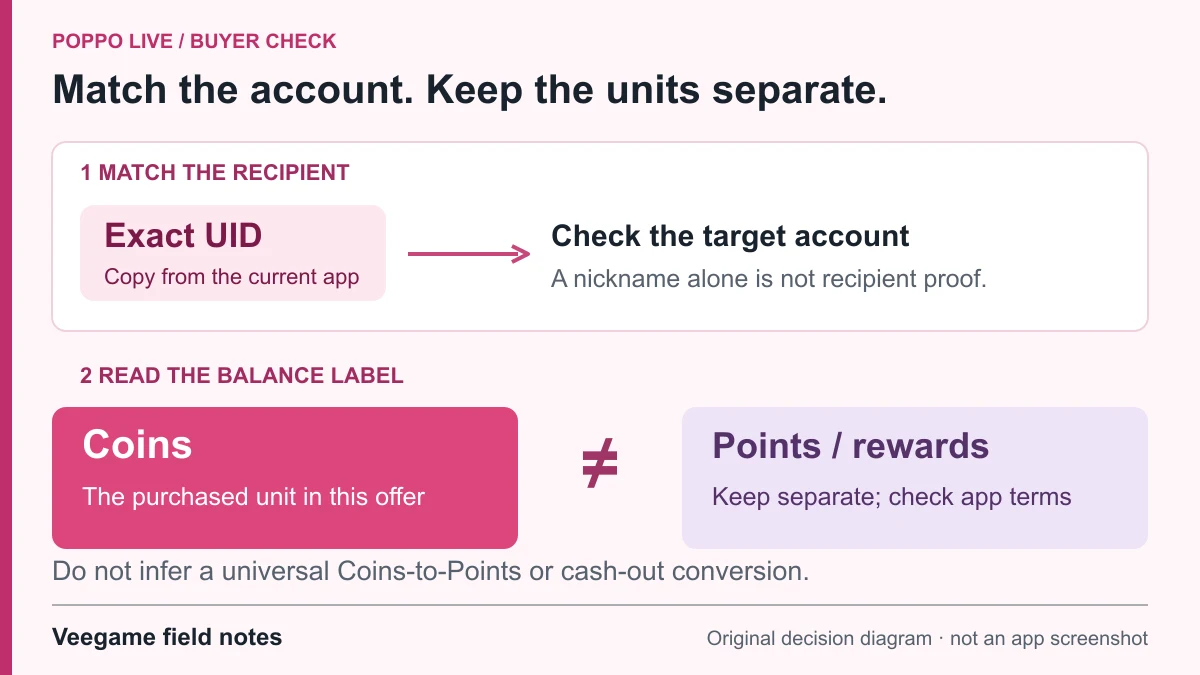
Original Veegame field notes · Primary reference. This is a decision diagram, not an app screenshot.
Sources and scope
The receipt checklist and support-note structure are original troubleshooting methods, not a record of a completed Veegame order. Platform references identify Poppo; payment and delivery must be checked against the actual order.
Editorial sourcing and correction-contact information are explained in our editorial approach.